Speed Without GPS
Dead reckoning only works if you can feed it a speed. Normally your GPS hands that number over without a thought — but the moment it goes dark, DR still needs one to keep running. Sailors have really only ever had three ways to find that number without an engine log or electronics: a mechanical log towed astern, a knotted line timed by hand, and a floating object timed past the hull.
One of those is now effectively unobtainable, one takes twenty minutes to build and then costs nothing to use, and one costs nothing at all and works the moment you think of it. All three are below, in that order — and all three are worth actually practising, the same way you'd practise a sextant sight, so the number they give you already has your trust built into it before the day you actually need it.
1. The Taffrail (Patent) Log — Know It, Don't Chase It
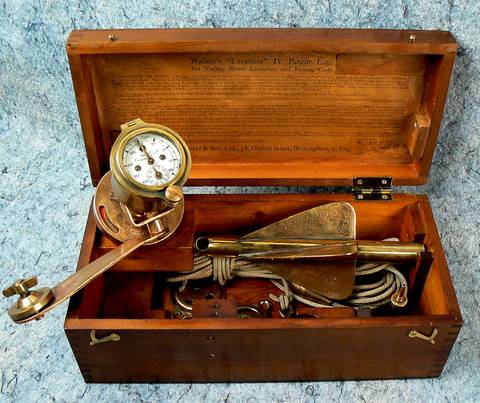
Before electronics, most offshore vessels measured distance run with a patent log: a small rotator, shaped a bit like a torpedo with spiralled fins, towed on a long line astern. Being dragged through the water spins it, and that spin is carried up the log line to a geared mechanical register mounted at the taffrail — the rail right at the stern, which is where the instrument gets its name. The register works exactly like an odometer: it accumulates distance run, in nautical miles, for as long as the log stays streamed.
Reading speed from it is just subtraction. Note the register, let a measured interval pass, then note the new reading. Six minutes — a tenth of an hour — is a convenient interval, since you can multiply the miles run by ten and have your speed in knots directly. No lookup table, no arithmetic beyond that one multiplication.
Worth being honest with your students about this one: it is no longer something you can simply go and buy. The two manufacturers left in this space, Walker Marine and Lilley & Gillie, only build electromagnetic (powered) logs today — nobody currently manufactures a new mechanical taffrail log. What exists is whatever is already out there in secondhand hands, on older boats, or in maritime collections, and that market is thin. Treat this one as recognition, not acquisition: worth knowing what it is and how it works if you inherit one or find one aboard an older boat, but not something to add to a shopping list.
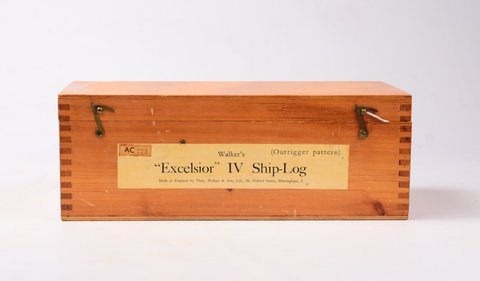
A real one, not a museum photo: a Walker "Excelsior" IV, made in England by Thos. Walker & Son, Ltd., of Oxford Street, Birmingham — the rotator, the towing line, and the mile-register dial, all still in their original fitted case.
2. The Chip Log — Build It Once, Read It Free
The chip log is where the unit "knot" actually comes from. Sailors tied a weighted, wedge-shaped board — the "chip" — to the end of a long line marked with evenly spaced knots, and paid it out over the stern. The chip's own drag held it roughly still in the water relative to the boat while the line ran out through a sailor's hands; another sailor counted how many knots passed in a fixed, timed interval, traditionally measured with a small sand-glass. Whatever number of knots ran out in that time was the ship's speed — literally, in knots. The knot spacing and the timed interval were chosen together, deliberately, so the count read straight off as speed with no arithmetic needed at sea.
You can build a working version of this in about twenty minutes with a length of line, something to act as a drogue at the working end, and a stopwatch — every phone has one built in, so there's no need for a sand-glass. The drogue just needs to offer enough resistance in the water to stay roughly in place while the line pays out past it: a small board, a rubber bung with a few holes drilled through it, even a weighted triangle of canvas will do the job. Tie the line to it, then mark the line with knots spaced to match how long you plan to count for each time you use it. The calculator below does that spacing for you.
A longer count — twenty or thirty seconds rather than ten — averages out the small speeding-up and slowing-down a hull does riding over waves, so it tends to read a touch more honestly in a seaway. Keep an eye on the drogue while you're streaming it: if it skips along the surface instead of dragging properly, the line runs out too fast and the reading will be optimistic.
My count didn't match my line — convert it anyway
If you timed a count that doesn't match your line's built spacing — you streamed it for longer than planned, or you're improvising with a borrowed line — this works out the speed from any combination of spacing, knots counted, and elapsed time.
3. The Dutchman's Log — Free, Always Available, Practise It Often
This is the technique of throwing something that floats and is biodegradable off the bow and timing how long it takes to reach the stern — and it has a real name: the Dutchman's log. It costs nothing, needs no preparation, and can be run the moment the thought occurs to you. A cracker or a biscuit is genuinely fine; anything that floats, won't harm the water, and is small enough to time cleanly past the hull will do the job.
Drop it at the bow, right at the point where the hull first meets the water, and start timing the instant it passes that point. Stop timing the instant it reaches a fixed reference point aft — the stern itself is simplest. What you've just timed is how long your boat's own waterline length took to pass a stationary object, which is exactly the measurement this calculator needs.
Be honest with your students about the one real weakness here: the baseline is short. An 11–12 metre waterline might only take three or four seconds to pass at a normal cruising speed, so a timing error of even a few tenths of a second is a meaningful percentage of the answer. Two things fix most of that: run it several times and average the results rather than trusting a single throw, and always time from the same two reference points so you're not introducing a new error each time. It won't match a GPS to the decimal place, and it isn't meant to — it's meant to get you close enough to keep a DR track honest.
The real value of this one comes from using it often, not just when you need it. Run it a few times whenever you're out and the GPS is still working, and compare the two. Do that enough times and you'll build two things at once: a genuine feel for how your own boat performs in different conditions, and an honest sense of how much to trust the Dutchman's log itself on the day it's all you have.
Which One Do You Actually Reach For?
In practice, the Dutchman's log is the one you'll use most — it costs nothing, needs no preparation, and works the instant you think of it. The chip log is worth building once and keeping aboard, since a well-built one is genuinely more accurate over a longer run and doesn't depend on your own timing reflexes as much. The taffrail log is worth recognising, not chasing.
None of these are meant to replace a working speed log or GPS. They're meant to mean dead reckoning never actually stops working — even on the day everything electronic does.